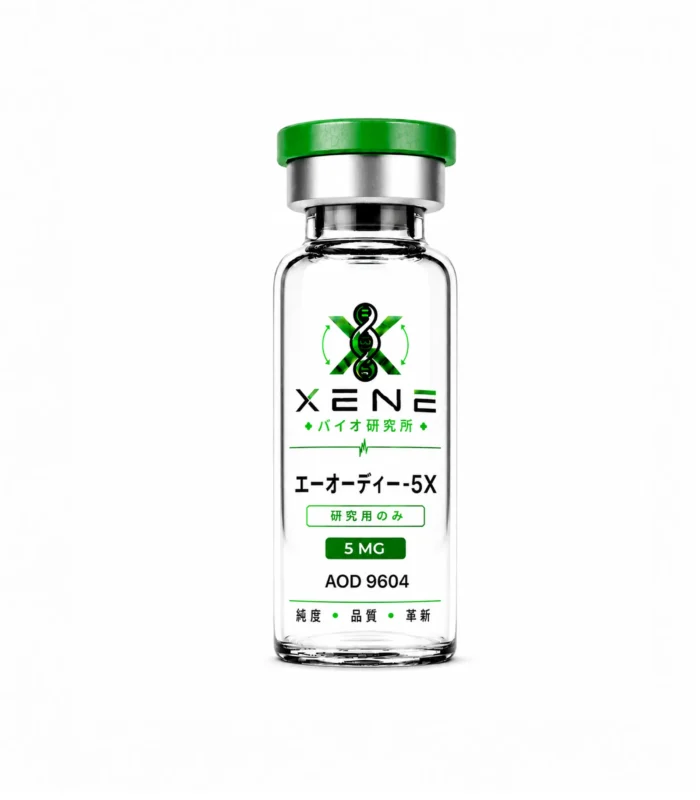
What is AOD 9604?
AOD 9604 is a synthetic peptide fragment of human growth hormone. It consists of the last 16 amino acids of hGH, residues 176–191, with a tyrosine added at the N-terminal. It was designed to retain the fat-burning, lipolytic domain of hGH without the growth-promoting or IGF-1 effects.
Regulatory status: Not FDA-approved for any medical use. Development was terminated in 2007 after phase 2 trials showed limited efficacy. It’s currently sold as a research compound or through compounding pharmacies. It’s banned by WADA for athletes.
How it works for fat loss
Mechanism
AOD 9604 mimics how hGH regulates fat metabolism. It binds adipose tissue and triggers breakdown of stored triglycerides while blocking new fat formation. Chronic use upregulates β3-adrenergic receptors in fat cells, reversing the obesity-related suppression of these fat-burning receptors.
What it does NOT do: Unlike full hGH, AOD 9604 does not meaningfully increase IGF-1, blood glucose, insulin sensitivity, or cause water retention, joint pain, or organ growth. It also doesn’t suppress appetite. Its effect is depot-specific to adipose tissue.
Evidence
- Animal studies: In obese Zucker rats, 500 mcg/kg oral daily for 19 days reduced body weight gain by >50% vs control, with increased lipolytic activity and no adverse effect on insulin sensitivity. In obese mice, 14 days of IP injections reduced body weight and fat and increased β3-AR expression.
- Human trials: A phase 2b trial in 300 obese patients used oral AOD 9604 daily for 12 weeks. The 1 mg/day group lost the most weight: 2.8 kg vs 0.8 kg for placebo. Weight loss rate was maintained throughout, with small improvements in cholesterol and glucose tolerance. However, later development stopped due to insufficient efficacy vs other options.
Dosing protocols used
Because it’s not approved, there’s no FDA protocol. Current info comes from clinical trials and research-use communities:
Protocol | Details |
Clinical trial oral | 1 mg/day orally was the most effective dose in the 12-week phase 2b trial. Doses from 0.25 mg to 10 mg daily were tested |
Common subcutaneous | 250–500 mcg per day, once daily. Some start at 300 mcg daily Weeks 1-4, then 500 mcg Weeks 5-12 |
Timing | Morning fasted, 30-45 min before food, or pre-workout. Works best when insulin is low |
Cycle length | 8–12 weeks, optional extension to 16 weeks |
Route | Subcutaneous injection with insulin syringe 29-31g. Abdomen, thighs, or upper arms. Rotate sites |
Injection | Some inject into stubborn fat areas, though spot-reduction data is limited |
Reconstitution
Typical vial is 5 mg. Reconstitute with bacteriostatic water. Example: 3 mL water = ~1.67 mg/mL. At 500 mcg/day, a 5 mg vial lasts ~10 days.
Storage
Lyophilized: -20°C, stable 1+ year. Reconstituted: 2-8°C, use within 3-4 weeks, avoid freeze-thaw.
Safety and limitations
- Efficacy: Human data is mixed. The company terminated development in 2007 due to limited efficacy. It’s not as potent as semaglutide, tirzepatide, or retatrutide.
- Side effects: In trials, tolerability was similar to placebo. No significant change in IGF-1 or glucose tolerance. Common issues are injection site irritation.
- Not approved: The 2023 Obesity Medicine Association position statement notes compounded peptides should only be used when FDA-approved drugs are unavailable.
- Athletes: Banned by WADA and tested for in competition.
Important notes
1.AOD 9604 is not FDA-approved for weight loss or any condition. All use is off-label/experimental.
2.If considering weight loss peptides, talk to a physician. Approved options like semaglutide and tirzepatide have robust phase
3. data and far greater average weight loss.
Don’t exceed 1 mg/day — higher doses didn’t improve outcomes and may cause desensitization.
4. Works best alongside diet/exercise. It’s not a standalone solution.